
My cat allergy disappeared in a day. A doctor told me why.
For a year my son Aleksander and I sat with the people working on how long and how well we live: 39 countries and states, more than a hundred scientists, doctors and experts.

For most of my adult life I had a strong allergy to cats. A single touch was enough: my skin flared up and breathing got hard. So I kept my distance.
Then, when the war in Ukraine began, a dear friend from Lviv had to flee with her family, and I offered them my apartment in Warsaw. Their cat was coming too. Nobody asks a family escaping a war to leave one of its members at the border. So I made a decision: from today, I don’t have this allergy. The cat moved in, and nothing happened. Since that day I can stroke any cat I meet.
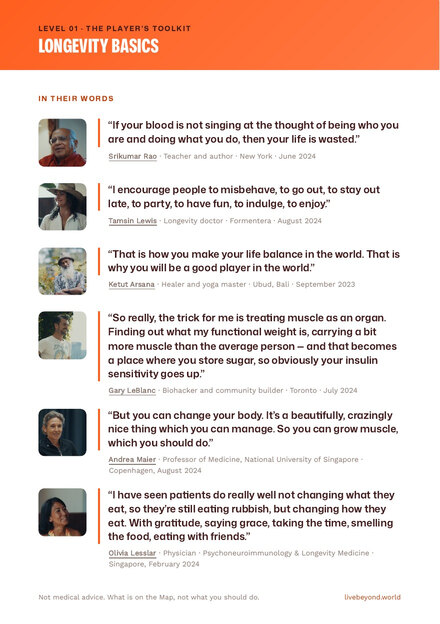
When I told this story to Olivia Lesslar, she wasn’t surprised in the slightest. Olivia is a medical doctor in functional and integrative medicine, and I call her the mind, heart and body doctor. Her favourite field has a long name, psychoneuroimmunology: the science of how what you think talks to your nervous system, your hormones and your immune system, and how they all talk back.
In Singapore we got onto placebo, the pill with nothing in it that every new drug has to beat, because expecting to get better is often enough to make people better. Medicine knows this and measures it in every trial. Olivia’s point was that it stops right there:
“… nobody turns around to go, ‘Wait, hang on a second. Are you saying that there is a pharmacy in my brain that can make whatever it is that’s going to give me the symptom I think I’m going to have, or get rid of the symptom I already have?’”
In most research, that pharmacy is noise to be subtracted from the results. Olivia would rather put it to work:
“… let’s leverage placebo, let’s leverage the fact that you actually make these chemicals in your own body just by thinking about something, just by thinking about it. I mean, that’s profound, right? That’s where the fun stuff is.”
It works the other way too, and that part made me think twice. She told me about a study with people who were allergic to peanuts:
“… patients who were allergic to peanuts … If you put a powder in the room and you said, “Oh, there’s peanut in that,” they would have the exact same reactions, right?”
That is the nocebo effect: expect harm, and your body can create it. The same mind that calmed my reaction to a cat can start a reaction to a powder with no peanut in it at all.
Your expectations don’t stay in your head. Your body acts on them.
Please don’t read this as advice to stop a medication or to test a real allergy. If you have a serious allergy, your doctor’s plan comes first. Read it as an invitation: what you expect, fear and believe is part of your health, and it deserves as much attention as your food and your sleep.
That is the kind of medicine I want for everybody, and it is why I am so grateful that Olivia kindly agreed to become the Medical Director of Live Beyond.
Has your mind ever surprised your body? I would love to hear your story. Tell me on Instagram: @longevityadvocate.
Why Olivia asks every patient where an illness started, why how you eat can matter as much as what you eat, and why she wears no wearables at all: it is all in the full story on the Live Beyond Hub:

The full article on the Live Beyond Hub
Let’s stop normalizing chronic disease.
13-minute read · 11 photographs · 4× longer than this page
Written by Marek Piotrowski. If you would like the Longevity Map that sits behind all of this, it is yours, with its Guide — ask for it here.
Get the Map and its Guide. The whole field on one page, and the stories behind it.
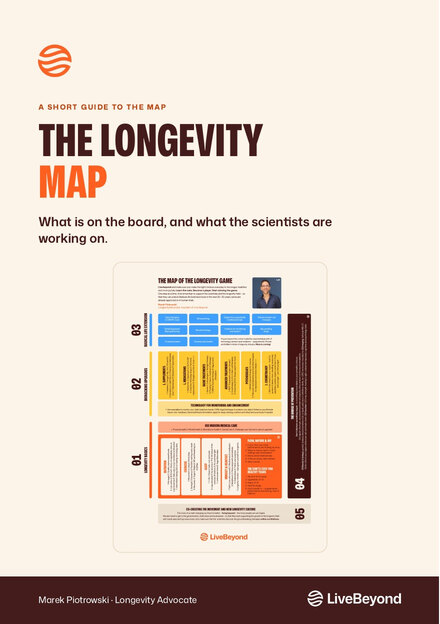
The Longevity Map will guide you to a longer, healthier and more fulfilling life. It gives you a helicopter view on all branches of the longevity field.