
Longevity, the Ultimate Multiplayer Game
When my son and I packed our bags for a year-long quest we thought we were chasing science. We came back with something bigger: longevity is a game we all play, and we win it together or not at all.
In 2023, my son Alek and I set off on a year-long journey around the world. We wanted to discover what science, medicine, and culture could really teach us about healthy aging. From conferences in Dublin and Boston to conversations in Singapore, Bali, and Chile, our goal was simple: to learn how to live longer and better — and to share that knowledge with others.
What we found, though, went far beyond science. Each encounter revealed a different piece of the puzzle—genetic breakthroughs, nutritional wisdom, psychological insights or spiritual practices.
But none of them alone held the whole picture.
Longevity wasn’t a single discovery waiting at the end of the road; it was something that unfolded, one insight at a time, through the patterns we noticed and the choices we made.
And if longevity has a destination, then there must also be a way to reach it. And that meant there were rules to follow, strategies to learn, and choices to make.
Suddenly it became clear: longevity has all the elements of a game. There are players and non-player characters. There are levels to unlock—from the basics of sleep, nutrition, and movement to advanced therapies and frontier science. There are risks and traps to avoid, and every decision counts. And there are allies who guide you along the way—proof that no one plays this game alone.
Once you see it this way, the whole landscape begins to unfold.
Choose Your Role
Every game has two kinds of characters: those who play—and those who don’t. The same is true for longevity.
Players are the ones who step in with intention. They experiment, adapt, and shape their future through daily choices. They train their mindset, strengthen their bodies, protect their sleep, nurture relationships, and stay curious about new science. They don’t always get it right—but they know they’re in the game, and they keep moving forward.
NPCs—non-player characters—follow a script. They repeat old patterns and wait for decline to arrive. NPCs say, “Aging just is what it is,” and live as if health were something beyond their control. They neglect prevention, outsource responsibility to luck or medicine, and accept disease as inevitable.
If you want to win the longevity game, you have to choose the role of a Player. But along the way, you’ll meet plenty of NPCs—people who cling to old scripts or resist change. Some will dismiss the game entirely. That’s part of the landscape, and recognizing it is a reminder of why playing with intention matters even more.
One of the most valuable lessons from our quest was that the line between Players and NPCs isn’t fixed. People can switch sides. Every time someone chooses prevention over convenience, movement over comfort, or purpose over distraction, they step into the role of a Player. And once they feel the benefits—more energy, clarity, and resilience—it becomes easier to keep playing.
No One Wins Alone
Along Players and NPCs, every multiplayer game has another group of characters—the allies. They’re the mentors, guides, and innovators who expand your vision, hand you new tools, and help you see what’s possible.
On our journey, we met many of them. George Church, the legendary geneticist, reminded us that aging is the most common disease—and that it must be treated as such. Andrea Maier, a physician-scientist at the forefront of geroscience, challenged us to see aging itself as a condition we can act on. Liz Parrish inspired us with her courage to test gene therapies on herself. Brian Kennedy welcomed us into his lab in Singapore and showed how translational science can move discoveries closer to people. And thinkers like Nicole Gibson and Srikumar Rao reminded us that mindset and emotional connection are as essential as biomarkers or therapies.
These allies didn’t play the game for us—but they changed how we played. Their insights became our strategies; their passion, our fuel. Over time, many became close friends.
They can be your allies too. Some are scientists and physicians, others are pioneers willing to experiment on themselves, thinkers who challenge how we see the world, or entrepreneurs daring to cross the boundaries of what’s possible. All share the same goal: to help humanity live beyond its current limits. And if they’ve been allies to us, then we must become allies to them—by supporting their work, amplifying their voices, and standing beside them as this movement grows.
You need the whole village
The Longevity Map—Levels of Play
Meeting all these people (Allies, but also other Players, and even NPCs) changed everything. They expanded my view, each revealing a different piece of the puzzle. But the more people we met, the more I began to realize just how immense this field really is. Suddenly, longevity was a continent, full of parallel paths and hidden connections.
Each expert illuminated a corner of it: nutrition, genetics, diagnostics, movement, psychology, prevention. Yet no one held the whole picture. And after months of listening, learning, and trying to piece it all together, I felt something unexpected—overwhelm. There were so many ideas, so many tools, so many ways to play this game.
I needed a way to make sense of it all. The more I learned, the more fragmented everything felt—sleep and nutrition here, genetics and diagnostics there, mindset and medicine somewhere in between. It was like staring at scattered pieces of a puzzle with no picture on the box. And that’s when it hit me: if longevity is a game, then it needs a map—something that shows where you are, what’s ahead, and how all the pieces connect.
There wasn’t one—so I decided to create it.
The result was something I came to call the Longevity Map. It wasn’t meant to be a perfect scientific model, but a compass—something anyone could use to see where they stand in the game, what comes next, and how to move forward with intention.
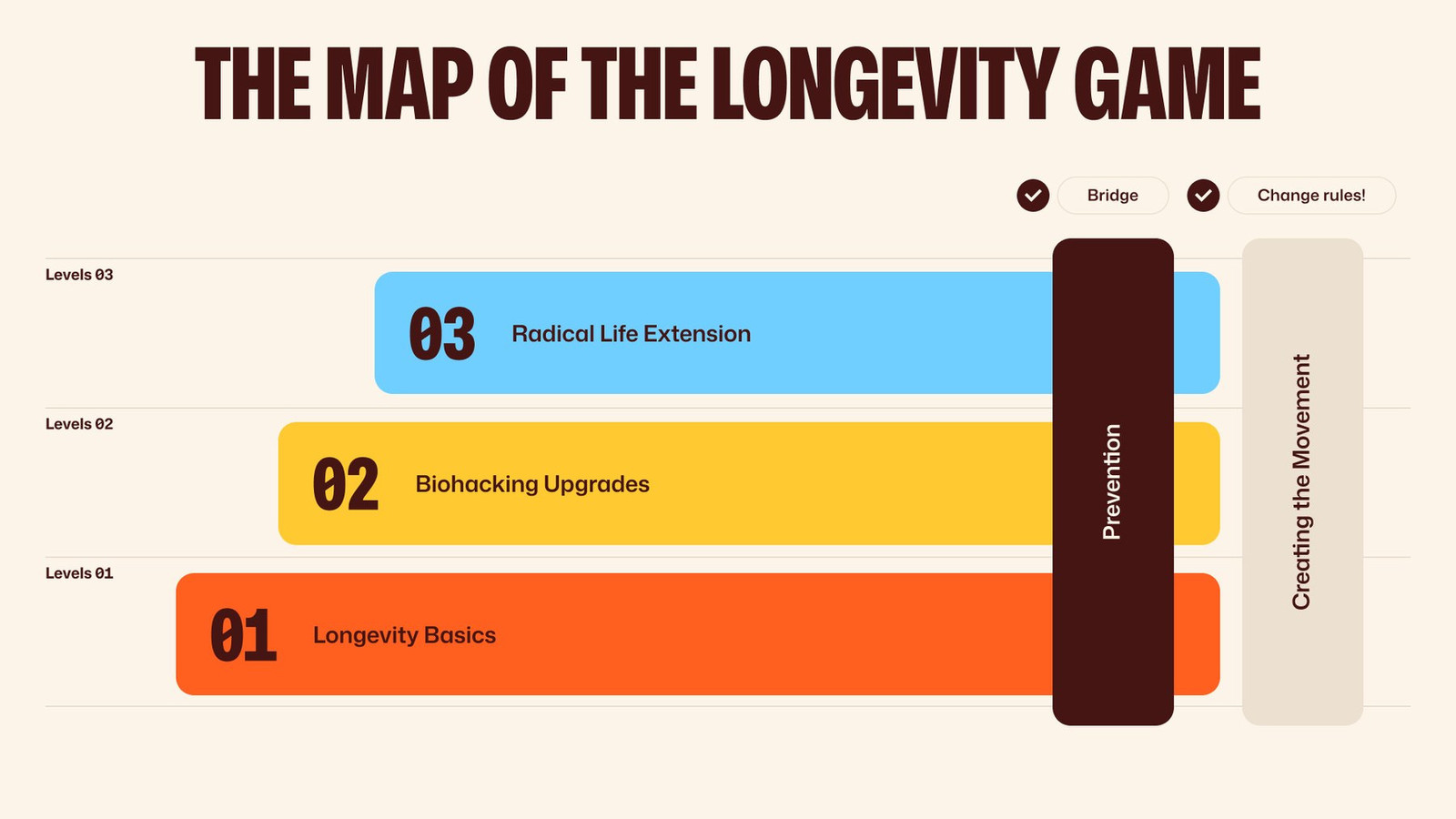
The map unfolds across three main levels, connected by a single bridge that ties them all together.
Level 1: Longevity Basics
This is where every player begins. The fundamentals—mindset, nutrition, sleep, movement, and flow—don’t require expensive tools, just consistency and attention. It means treating your body, mind, and heart as a temple, fueling yourself with real food, strengthening your muscles, protecting your sleep, and cultivating purpose and joy. These basics sound simple, but mastering them is the hardest and most important part of the game.
Level 2: Biohacking Upgrades
Beyond the basics lie the upgrades—interventions that require more resources and intention. Here are wearables and diagnostics that track how your body is aging, therapies like hyperbaric oxygen, saunas, cold plunges, and red light, and the growing frontier of psychedelic care for emotional healing. Some tools are well established, others still experimental, but together they expand your capacity, slow decline, and open new ways to optimize healthspan.
Level 3: Radical Life Extension
At the edge of the map is the frontier. Gene therapies, partial epigenetic reprogramming, 3D bioprinting, digital twins, cryonics—technologies still in their early stages, but with the potential to change the rules of the game entirely. These are the boldest visions, the moves that could one day reset our biological clocks and redefine what it means to age.
The Bridge of Prevention
Running across all three levels is prevention—the thread that holds the game together. Prevention means regular diagnostics, conscious lifestyle choices, and avoiding the silent killers that develop over decades.
It’s captured in one blunt rule: “Don’t die from something stupid.” Most of the diseases that take lives—heart disease, cancer, diabetes, neurodegeneration—build up silently for 20 to 30 years. Prevention is the act of seeing them coming before they arrive. But you have to test yourself first. Andrea Maier once said it perfectly: “If your engine is failing, you don’t fix it by painting the exterior.” Yet that’s exactly what many of us do—we focus on how we look or how we perform in the moment, worrying about whether we feel good today, while ignoring what may be quietly breaking down beneath the surface.
Like in every game, there are habits to master and challenges to face on every level. Progress isn’t always linear—you’ll stumble, restart, and sometimes feel like you’re standing still. But habits are the real skill tree of longevity. They’re the daily moves that build endurance, focus, and resilience. The Map can guide you, and allies can help you strategize, but the practice itself is yours. You have to play.
We are now building “The Live Beyond universe” to make this game easier to navigate —through the movie, series, book and community, to inspire you and to guide you to make the right choices in your everyday game. It’s where stories, tools, and science come together to help you stay curious, consistent, and connected. Because longevity is a shared world that keeps expanding with every Player who decides to join.
The Map Isn’t the Territory: Winning the Longevity Game The real endgame is not immortality—at least not yet. It’s learning how to live beyond the fear of aging, beyond decline accepted as inevitable, beyond the narrow focus on lifespan alone.
Winning the longevity game means showing up present in the years you already have, while creating the conditions for more years filled with energy, clarity, and love. It means learning the rules, leveling up, finding allies, and refusing to play on autopilot.
But even with all the strategies, science, and structure we now have, it’s worth remembering what the philosopher Alfred Korzybski once said: “The map is not the territory.” The Longevity Map is not life itself—it’s your guide, not the ground. It shows where you might go, but it can’t walk the path for you. The real territory is the living experience: your habits, your mindset, your community, your choices.
That’s also what makes this a multiplayer game. Allies can guide you, but they can’t take your turn. Other Players can inspire you, but they can’t make your moves. And NPCs—the ones who wait on the sidelines—will always be there, reminding you what happens when you stop playing altogether.
The only question left is: will you choose to play? And what if you don’t?
Marek Piotrowski, Longevity Advocate ↗
The film and the book are coming in 2026 — the story behind this journey.
The Film · The Book · More articles →
Written by Marek Piotrowski. If you would like the Longevity Map that sits behind all of this, it is free — ask for it here.
Get the Map. It is free, and it is the whole field on one page.
The Longevity Map will guide you to a longer, healthier and more fulfilling life. It gives you a helicopter view on all branches of the longevity field.